

A note before we get started. This piece is equal parts a reflection on the life and contributions of the late Hilde Lynn Helphenstein (aka Jerry Gogosian) and an op-ed on what it means to navigate a cultural moment that is defined by increasingly authenticated, curated, and scripted technocentric norms. Digitally-native distribution is transforming the concept of "engagement" in culture, identity, and credibility, challenging what it means to be perceived as real, human, and dignified in an era of cultural uniformity and algorithmic censorship. Hilde was already leading the way and setting the rules in a different reality we all experience to some extent.
Hilde was known to most as Jerry Gogosian, a persona she ran anonymously for years before her identity became public. Helphenstein built something that had no business being as sharp as it was, but somewhere in the middle of the pandemic, while I was still working in finance, I came across her meme account on Instagram. Immediately drawn by her ability to blend pop culture and art-speak with true market analysis underneath, she delivered a wit-to-credibility ratio I was willing to follow for the foreseeable future - the kind that only someone who genuinely understood and navigated rooms alongside fine-arts and finance elitists could ever pull off. She appreciated the nuance of the worlds she operated in - and, in equal measure, was unafraid to call out the bloat, maximalist exuberance, and exclusivity of it all - she was there for it. She was also unafraid to go after figures who had long dictated the art market's terms with what the Italians call “sfacciataggine”, a kind of unabashed nerve that says the thing nobody else will say without flinching, in the same way a Chihuahua would a much larger dog, and I mean that in the best way. I recognized what she was serving, and I was there for all of it.
Left-Brain, Right-Brain
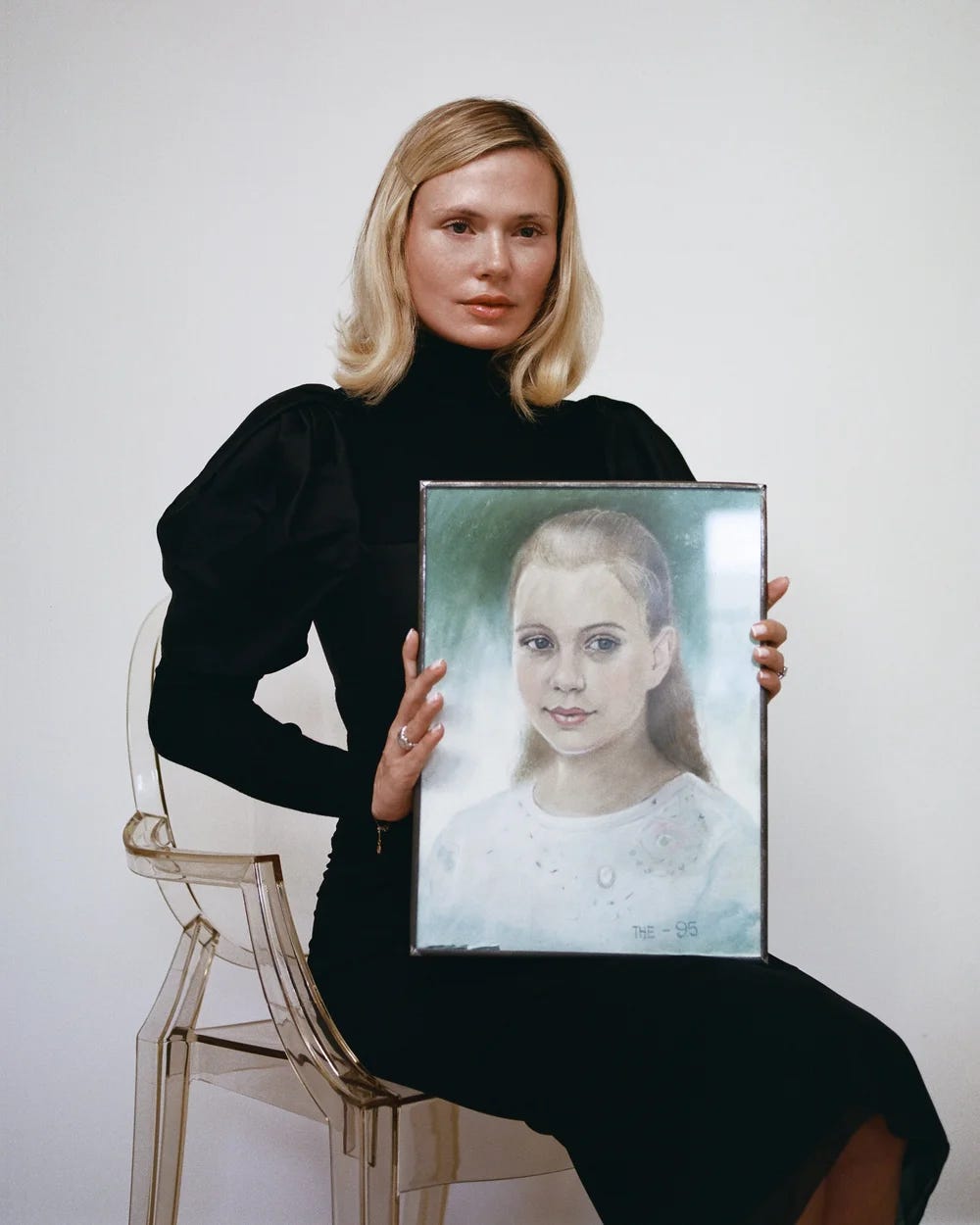
If art metaphorically represents the left brain and finance and market analysis the right, Hilde navigated both with equal fluency, and with formal credentials to match. She studied finance at NYU Stern School of Business. [21] And in the commentary that has followed her untimely passing, almost nothing has been said about her command of the right. That absence says as much about the art world’s relationship to its own economics as anything she ever posted.
She worked the front desk at Gagosian Gallery in San Francisco, her self-described last paying job before building Jerry Gogosian, within the world's most commercially powerful gallery infrastructure. Some years later, while I was working at First Republic Private Wealth Management in San Francisco - a key initiative I supported across Advisor Enablement was data attribution of net worth across portfolios of assets held away (AHA)- she was dissecting the buy-side and sell-side of that exact asset class, its collectors, benefactors, and auctions - different cuts of the same plane. Fast forward to now, and it is not lost on me that The RWA Ledger exists in part because of that work; contextualizing the realities of getting real-world assets on-chain, verifiable, and integrated into financial infrastructure is now one of the most active areas of development across the tokenized asset space, a topic worthy of its own follow-up piece. Full circle doesn't quite cover it - but I would have loved to have had that conversation with her had our paths crossed, and for all of these reasons and more - a tribute felt not just appropriate but necessary.
When I learned of her passing this week, I was struck by the brevity of the weight of the hole her existence will no longer fill. Not within me personally, but within the community she cultivated, and in the impact she left, for better or worse. If anyone was equal parts artist and critic, it was Hilde.
Proof of Name
Jerry Gogosian was her proof of work and proof of verification rolled into one. A name that authenticated itself before she ever attached her own to it. To understand her is to understand the identities of the two men whose worlds she had spent years cataloging. What followed was seven years of unscripted documentation across Instagram, Substack, and her podcast Art Smack - a real-time archive of one person's attempt to remain legible, human, and unfiltered inside an industry increasingly hostile to all three. In an era of AI-generated sameness and algorithmic curation, she was doing the opposite by instinct - by survival, before the cultural conversation caught up.
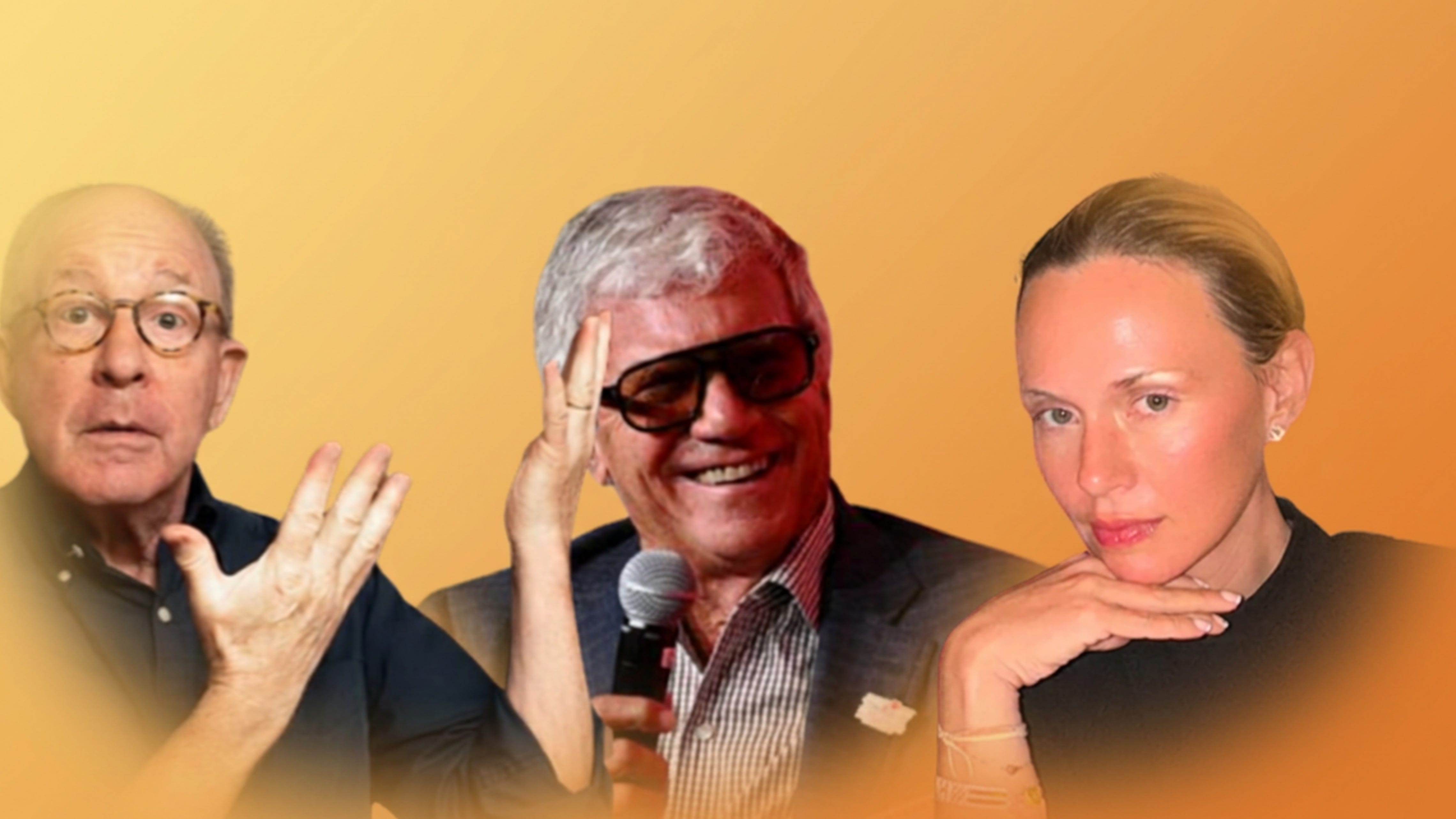
What’s In a Name - Jerry, Larry, & Hilde
Jerry Saltz has shaped the landscape of art criticism for three decades: the Pulitzer Prize, New York Magazine, the long-form critical apparatus that gave serious art writing its institutional home. [1] A self-described failed artist turned people's critic, spearheading democratic art communication and opening criticism to participatory exchange. [2] Larry Gagosian built the other side of the equation: a gallery network spanning 19 locations across four continents, generating over a billion dollars in annual sales [3], and brokering Andy Warhol's Shot Marilyns for a record $195 million, the most expensive 20th-century work to change hands at public sale. [4] Two men, different ideological postures: access versus accumulation, conscience versus commerce, the outside view versus the inside grip. Saltz moved the needle on what criticism could say. Gagosian moved the needle on what the market could absorb.
She fused them, ran anonymously beneath that fusion for years, and, in doing so, moved the needle on what criticism could be. That fusion was a direct reflection of the duality that existed within her - that defined her - and would be remembered posthumously as her persona arc.
Beneath the meme format, she was performing cultural analysis viewed through a market lens. She explored how value and valuation are created in the art world, focusing on the brokers involved, their terms, and what these reveal about the institutions shaping those valuations. With a dialed-in eye for what was hypervalued, undervalued, overlooked, or deliberately obscured, she was doing something the art world had never seen but that anyone in private equity or venture capital would recognize immediately: conducting deal-level due diligence on cultural assets in real time, in public. As recently as December 2024, in an Art Smack conversation with art dealer Adam Lindemann, she was doing exactly that — dissecting Patrick Drahi’s 2019 acquisition of Sotheby’s for approximately $3.7 billion, the subsequent $1 billion minority stake from Abu Dhabi’s sovereign wealth fund ADQ, and a capital structure carrying approximately $60 billion in broader telecoms debt, [22] with Lindemann noting that Drahi had never been a collector, never a cultural participant, a capital allocator who bought the brand, and that if his position became untenable the institution would transfer to sovereign capital.
She had wit, an innate sixth sense, and a recognition of who was being marked up beyond reasonable fundamentals. Who was being passed over despite clear underlying value. Which galleries were running the equivalent of a pump-and-dump on emerging artists, and which collectors were cornering supply to manufacture scarcity. She had no Bloomberg terminal, no cap table, no data room. She had adept pattern recognition, insider access, and 150,000 followers who trusted her to read.
In any other market, that is called research.
When she called out Gagosian director Sam Orlofsky for inappropriate workplace behavior, he was dismissed shortly thereafter. [19] When she turned her algorithmic reach toward emerging artists, it became a Sotheby's sale: "Suggested Followers: How the Algorithm Is Always Right," a 2022 show built entirely on artists her platform had surfaced. [20] The analysis had consequences. That is what separates a critic from a market force.
She also highlighted a more troubling issue: the disconnect between institutional language and actual behavior. The art world, like many sectors, is notorious for using the vocabulary of progressive ideas while the real power structures stay largely the same. She examined identity narratives through a market perspective similar to how she analyzes pricing and gallery representation - pointing out who gains from this framing, what benefits the institution derives from using this language, and where accountability lies. She skillfully balanced questioning the declared values against their implementation. Despite the impact of her voice, her ego and self-perception remained highly sensitive.
Where It Came From
Jerry Gogosian was more akin to a survival strategy finding form. In 2018, following a near-fatal tick bite that put her in the ICU for weeks, blind, deaf, unable to use her hands or feet, Hilde spent eight months bedridden making art world memes six or seven a day just to stay sane. [5] The account that would eventually carry 150,000 followers, [6] a Sotheby’s curated show, and a UTA signing began as a way for a person to feel less alone inside a body that had nearly killed her. There was no defined audience she was building toward as she rehabilitated in her childhood bedroom at her parents’ home in Florida. There was a 33-year-old woman with a phone, a specific way of seeing, and a world she had been locked out of. Her anonymity served as a protective shield, allowing her to create something meaningful without linking it to her name, offering unfiltered analysis without repercussions, at least for a time. She hadn’t yet been pressed into the role of managing a personal brand, and her work could stand independently on its own terms.
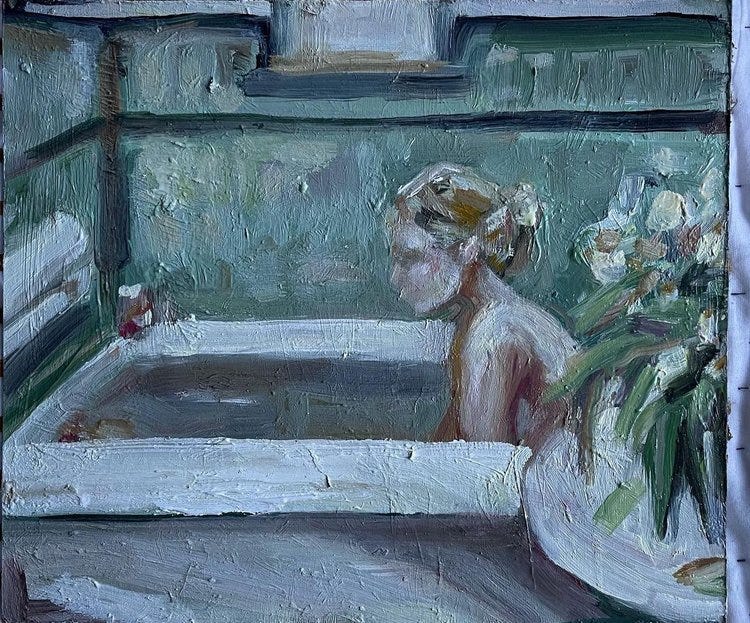
That changed in 2020, when Artnet News columnist Kenny Schachter publicly confirmed her identity. [22] The shield came down whether she was ready or not. What had been a body of work now had a face, a name, a biography - and with that came the full weight of public expectation, institutional scrutiny, and the particular kind of exposure that the art world reserves for people who have been saying uncomfortable things about it anonymously for years. The reconciliation between who she had been as Jerry and who she now had to be as Hilde was by no measure a smooth transition. It was a collision.
What her audience was largely unaware of, until she chose to tell them years later on her Substack, was the weight of some of the darker lived experiences she’d been carrying the entire time. A self-described survivor of an abusive religious cult - as well as someone still reeling from the ramifications of a life-threatening illness- who was in her fifth year of sobriety. [7] There was a lot she began disclosing publicly - unpacking for all to see - only after six years of being known as Jerry - a lot to manage for someone who’d remained anonymous for several years. On her Substack, she wrote that after all of it, she finally wanted people to begin to know who she actually was - on her own terms, in her own time, which was very different from having that choice made for her.
The version of Hilde that the art world encountered as a precise and fearless individual, notoriously vocal in exposing overvaluation, institutional hypocrisy, and the conflation of cultural virtue with commercial appetite, was constructed by someone whose biography was not traditionally well-suited to the audience she was trying to reach. In this context, it’s crucial to consider whether anonymity is a form of evasion; sometimes, it may be the only condition allowing a certain type of person - whose interest in a specific space - to exist.
What the creator economy has not seriously reckoned with is what it extracts from people when the conditions providing protective shielding are removed, and, when the shield comes down - whether by choice or by someone else’s decision - the full apparatus and cost of public identity and the recourse of audience expectation, algorithmic performance, and scrutiny lands on a person.
In many instances, those individuals may be managing depression, anxiety, neurodivergence, addiction, or trauma that the platform was never designed to accommodate and that visibility actively inflames.
Behind the account, the persona, and platform - creators are humans. So when the world is watching, when the algorithm is measuring, when the audience is expecting - what are we actually asking of the people we follow?
What Happens When the Thing You Build to Survive Becomes the Thing That Consumes You
There is no answer to this question…
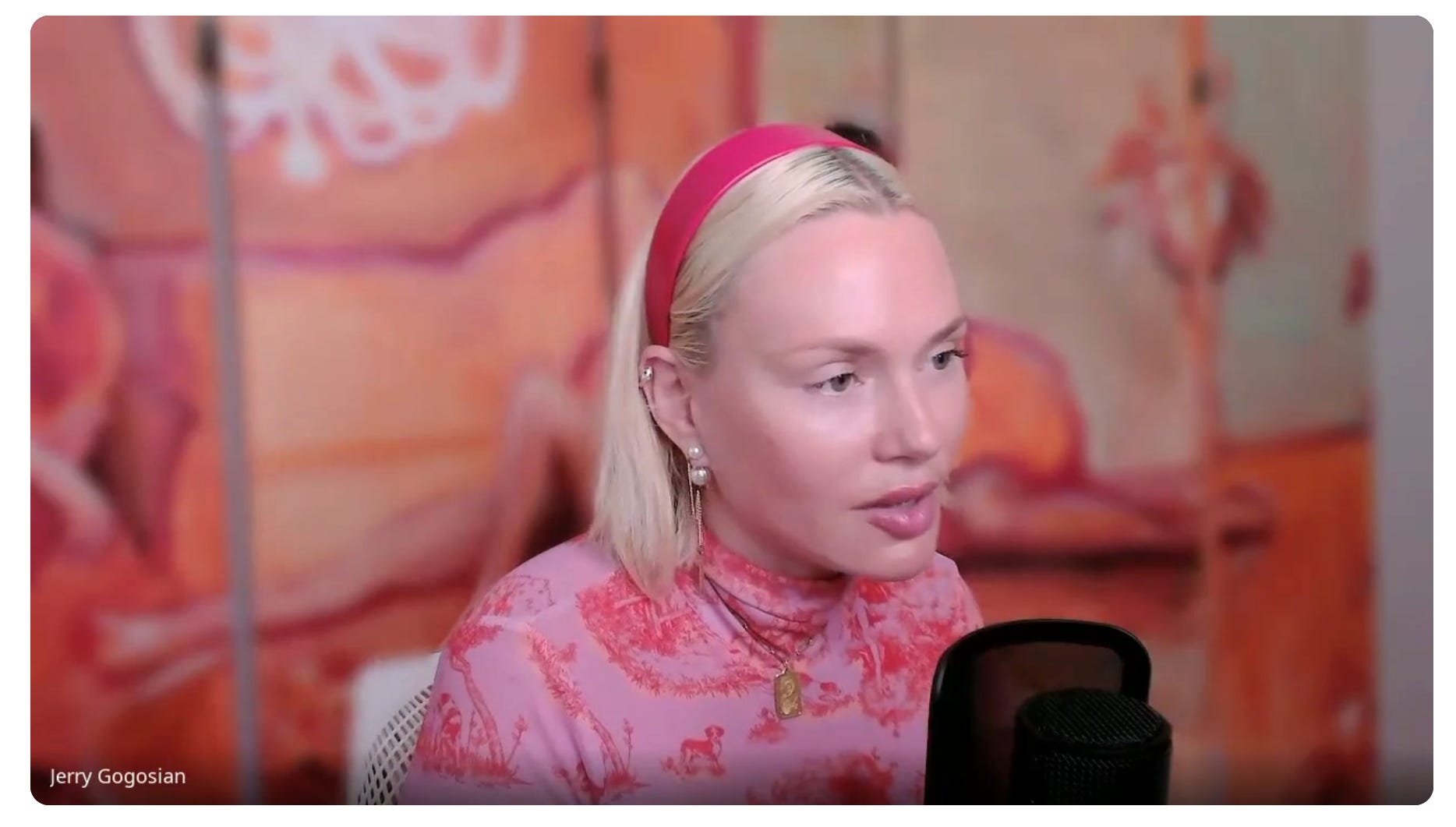
The platform that began as a survival mechanism evolved into something many later would coin an “institutional spectacle.” Art Smack, her podcast, launched in 2022 and expanded into longer-form conversations about the art market, often surfacing conversational dialogue about the conditions of the space - amplified through her satirical banter with others she included on the show. [8] New formats, new audiences, increased exposure, and expanded surface area. However, by the time she spoke to Forbes about her clear departure from her Jerry Gogosian project, she was managing 16 project flows simultaneously. She mentioned hiring a media coach to help her improve her speaking and a stylist to guide her wardrobe choices. All this while dealing with analysts, strategists, and the spectacle of being a highly visible and polarizing figure in social discourse, constantly scrutinized for what she might be doing wrong. Her own words: “I was drowning.” [9]
What she described in one of her later Art Smack episodes was something more unsettling than burnout. Jerry Gogosian had evolved from a meme engine into a living, walking performance, in which even the most banal moments of daily life became content, whether she wanted them to or not. [10] She described coming home from the highs of art fairs and meetings and the attention that followed her everywhere, standing in the silence of her own apartment wondering: what was all that, and who were all those people? Needing to dissect who was a friend, who was an enemy, who was there for the access she represented and who was there for her. That is a specific tax on people who build something that becomes a gathering place for others while they are still trying to figure out how to live inside their own life.
She repeatedly emphasized that she does not have a “poor me” attitude, a stance common among top performers who operate at their limits in visible roles. Many believe that high sensitivity and high performance are unrelated, but they often stem from the same or at least adjacent wiring, functioning side by side. Sensitivity enhances perception, yet it is rarely openly recognized. While performance earns recognition, sensitivity tends to remain private or unnoticed.
Anthony Bourdain exemplifies someone who created a highly recognizable persona. At the same time, he struggled to manage the vastness of his public image, which grew increasingly difficult to control as his private life became more and more exposed and scrutinized. His calendar and scheduling also made it harder to live in and navigate that space, and ultimately exacted an unimaginable and profound cost on his existence.
The Brand-Identity Trap
Women who create public platforms driven by genuine conviction face distinct pressures that are difficult to fully capture from the outside. Their room for contradiction is limited, and the risk of being misunderstood is higher. They must project a consistent, acceptable, and clear public image across all audiences, a challenge that grows with their reach. Anonymity can seem like an obvious solution, providing some distance to speak freely about sensitive topics. However, over time, this separation can prove insufficient if an account holder’s identity is exposed.
What she described in interviews- online pile-ons, extreme political accusations, the art world taking visible pleasure in her public failures while remaining silent during her successes [11] is a recognizable pattern for women who publicly name who profits, who decides, and whose work gets elevated by those willing to perform membership on the industry’s terms. The art world runs on overlapping legitimacy filters — the MFA, yes, but equally the collector who noticed you first, the gallerist who took your call, the dinner table you sat at. These structures are as rigid as any academic credential and far less transparent. She understood them completely. She just refused to perform the specific version of membership the industry expected, and an industry that confuses commercial appetite with cultural virtue has very little tolerance for someone willing to name the contradiction out loud.
She also visibly questioned and struggled with the nature of female friendship within high-stakes creative industries: whether the competitive, highly visible environment allows for genuine support, or whether it makes such support difficult due to its structure. This issue is equally relevant in digital assets, financial services, and any sector where credibility is key, and vulnerability poses risks. Business remains business, and the risks are significant. The key question is whether support and authentic relationships can be established in high-pressure or transactional environments, which are more likely to occur. Is trust and genuineness inherently absent or impossible to attain in such settings? Many argue that it depends on the conditions fostered and the resilience of the individuals involved, while others recognize that achieving this is unlikely.
Conviction and Its Cost
We are living through a specific kind of inversion.
The volume of information being produced now defies comprehension in the most literal sense. Humanity creates over 403 million terabytes of data each day, and more than 90% of the world’s data was created in just the last two years. [12] The instinct that more information produces better judgment turns out not to hold. Research on decision fatigue shows the opposite pattern: exposure to excessive information forces the brain toward heuristic-based shortcuts, faster categorical sorting, and identity-protective reasoning rather than more careful analysis. [13] Pew Research found that eight in ten U.S. adults say Republicans and Democrats cannot agree on basic facts, not just policies, [14] a finding that speaks less to ignorance than to the cognitive defense mechanism of categorizing before engaging. The segmentation is not a failure of intelligence. It is a rational response to an irrational volume of input, and it is accelerating because the volume is accelerating. The result is a cultural environment where people arrive at conclusions faster, hold them more rigidly, and have less tolerance for anyone who operates across the lines those conclusions have drawn.
Hilde Helphenstein didn’t fit the segmentation. Too market-focused for the pure art crowd, too art-focused for the finance world, too personal for institutional credibility, too institutional for pure personal authenticity. Too liberal for some, too willing to call out progressive performance for others. She operated across categories because her work required it, and the culture punished her for refusing to simplify.
Consumer preference for AI-generated content dropped from 60% in 2023 to 26% in 2025. [15] The market is registering a hunger for something that resists manufacturing: the messiness, the specificity, the texture of a human perspective that has actually lived inside the thing it is describing. What she was doing on Art Smack and the Substack, raw, personal, willing to be seen struggling, was the inverse of the tonal flattening that AI-generated content produces at scale. She was doing it before anyone had language for why it mattered, at personal cost, in public, without a net.
The same extraction dynamic she identified in the art world- authentic language lifted from genuine movements and repackaged as institutional positioning- runs identically in digital assets. Decentralization, access, democratization: used as brand language by projects and platforms that reproduce exactly the access structures they claimed to be disrupting. Narrative control is not a left problem or a right problem. It is a power problem. Every institution, every market participant with enough scale, eventually reaches for it. The lever is the same. The branding changes depending on who is pulling is the strings.
In that same December 2024 Art Smack conversation with Lindemann, Helphenstein extended the Drahi analysis into a broader conversation around the duopoly that is Christie's and Sotheby's to discuss game theory, specifically mutually assured destruction, two institutions competing each other into diminishing returns with neither able to exit without catastrophic consequence, and grounded it in the de la Cruz collection: a legendary Miami institution dissolved after Rosa de la Cruz's death in 2024, its works consigned to Christie's in a sale simultaneously undermined by a cyberattack that took the house's website offline mid-auction, with lots withdrawn and totals falling well below estimates. [23] A cultural legacy reduced to a capital markets stress test. In any other market, that analysis would have carried a byline in the Financial Times.
She called that pattern in the art world with a precision that made people uncomfortable, and that is what gets you labeled as everything from conservative to radical depending on the week and whose position is being examined.
Conviction is the pursuit of great minds, even when it carries a cost. The outcome is not determined by the conviction alone. It is determined by two things meeting each other: the mirror that culture holds up, and what the individual is predisposed to do with their own reflection in it. Those two things together determine what the cost actually is.
What Remains
After six years of being known as Jerry, Hilde began trying to separate the person from the thing she had built. The Jerry Report continued, but the Substack became something else, the place where she disclosed what she had been carrying, where she asked to be known as herself. “After six years of being known for Jerry,” she wrote, “I would like people to begin to know who I am.” [16] She described a journey toward self-sufficiency, creativity, and hope. She wrote about the illness, the cult, the sobriety, and what it had taken to get to a place where she could say any of it out loud.
Last year she announced she was letting Jerry go. “I have so loved and enjoyed being Jerry, but it is time.” [17] She wanted to write, to develop television projects, to exist in public as Hilde Helphenstein rather than a persona that had grown larger than the person inside it. The clean exit never came. The persona had its own momentum, its own audience, its own gravity.
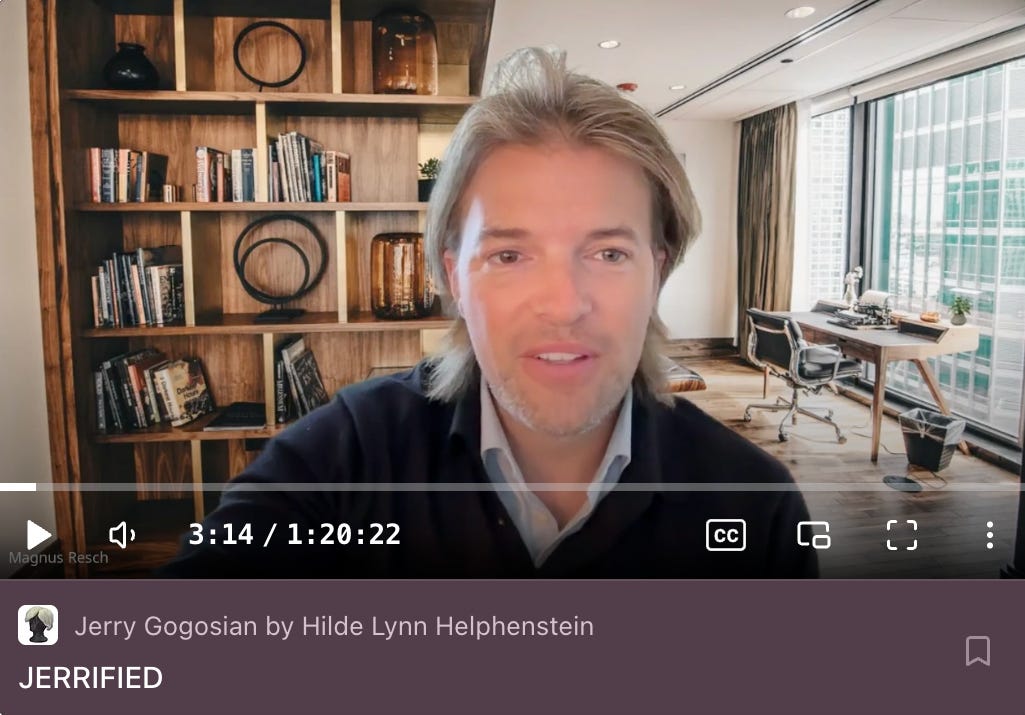
In a February 2025 Art Smack conversation with Magnus Resch, [24] she described feeling as though she had been permanently living on a psychedelic given to her at birth, her way of articulating a perceptual experience that resisted clinical language, someone who, in her own words, doesn’t" “easily slide into the normal world.” She was talking about her decision to sell her Connecticut house and move to Zurich, a deliberate attempt to break from the cycles that had accumulated around her, to find a version of herself that wasn’t tethered to the machinery of what she had built. In that same conversation, she said she wanted to kill the Jerry project. You could hear the exhaustion of someone trying to convince themselves that the exit was possible when everything in their infrastructure was pulling them back.
She was forty years old. She was found alone in a hotel room in São Paulo, and the circumstances of her death remain under investigation. [18] Whatever the facts ultimately show, the life itself was legible. The community that formed around her work knew enough to know that she was carrying something heavy, and to feel the weight of that over the years. There is dignity in honoring that without resolving it into something tidier than it was.
Her creations held profound significance. Her absence leaves a palpable void, and its effects on the art scene will endure because honest critique isn’t easily replaceable - even in an age saturated with AI-generated content. There is no perfect replacement for someone who truly understands a milieu and dares to speak in truth - whether uncomfortable or not. Anyone aiming to express their true self in areas such as finance, digital assets, media, politics, culture, animal welfare, STEM, or the arts faces a challenge similar to hers: what happens when survival becomes your primary concern? What are the implications when inner conflicts emerge? How can we communicate in a manner that acknowledges personal duality while ensuring it remains healthy and respectful of broader cultural and social norms, especially when polarization and conformity are conflated as the dominant standard? She went through this openly and completely, without a safety net, creating something memorable in the process. In a world where verification is widespread but authentic human connection is scarce, what is the true cost of remaining truthful to oneself?
The views expressed in this piece are solely those of the author and The RWA Ledger and reflect the author’s personal observations and opinions. Nothing contained herein constitutes financial, investment, or legal advice, nor does it represent the positions of any companies, organizations, or individuals mentioned.
Sources
[1] Jerry Saltz, Senior Art Critic, New York Magazine.
[2] Kenny Schachter, “Jerry Saltz and the Future of the Critic-Artist,” Artnet News, December 2016.
[3] Financial Times, “I like the way things look: The world according to Larry Gagosian,” 2022.
[4] Wikipedia, “Larry Gagosian,” accessed June 2026.
[5] Bad at Sports, Episode 923: “Hilde Lynn Helphenstein is Jerry G, Part 1,” December 2025.
[6] Hyperallergic, “Hilde Lynn Helphenstein of ‘Jerry Gogosian’ Found Dead in Brazil,” June 2026.
[7] Hilde Lynn Helphenstein, “Hilde’s Story,” Jerry Gogosian Substack, September 2024.
[8] Bad at Sports, Episode 924: “Hilde Lynn Helphenstein is Jerry G, Part 2,” December 2025.
[9] Cultured Magazine, “Hilde Lynn Helphenstein, Who Memed the Art World as Jerry Gogosian, Is Dead,” June 2026.
[10] Bad at Sports, Episode 924: “Hilde Lynn Helphenstein is Jerry G, Part 2,” December 2025.
[11] Bad at Sports, Episode 924: “Hilde Lynn Helphenstein is Jerry G, Part 2,” December 2025.
[12] SpeakWise, “Information Overload Statistics 2026: Data Overwhelm, Decision Fatigue, and Cognitive Limits,” January 2026.
[13] Ali SMS, “Cognitive Biases in Digital Decision Making: How Consumers Navigate Information Overload,” Advances in Consumer Research, February 2025.
[14] Pew Research Center, “Political Polarization,” July 2025.
[15] eMarketer / Billion Dollar Boy, “Consumers Feel Increasingly Negative About AI in the Creator Economy,” November 2025.
[16] Hilde Lynn Helphenstein, “Hilde’s Story,” Jerry Gogosian Substack, September 2024.
[17] FAD Magazine, “Jerry Gogosian Creator Hilde Lynn Helphenstein Dies Aged 40,” June 2026.
[18] ArtReview, “Hilde Lynn Helphenstein, Artworld Satirist Behind Jerry Gogosian Persona, 1985-2026,” June 2026.
Thank you for this thoughtful tribute.
I did not know Jerry Gogosian before this piece, and I’m grateful you helped me understand her work, voice, and legacy.
May she rest in peace.