

It has been a few weeks since my last piece. Not for lack of activity - if anything, the opposite. I relaunched the Tiburon Advisory Group website, did more prep calls ahead of Consensus than I expected, and somewhere in there found time to do some light rebranding of The RWA Ledger itself.
One of those meetings has stayed with me. I had a chance to connect with a reader of this publication -- a Risk Officer at a regional bank in the Midwest -- ahead of Consensus. We spent an hour talking through what she is seeing from her seat. Her read: many regional banks are still in wait-and-see mode, and the decision points around digital assets and tokenization at institutions like hers remain largely predicated on greater clarity at the regulatory and compliance levels. That conversation revalidated why this year’s Consensus in Miami feels worth paying close attention to, not just for what gets said on stage, but for what it tells us about how non-crypto-native institutions are thinking heading into the rest of 2026, and how much the compliance and risk function has shifted from “do we need to care about this” to “how do we get ahead of it.”
It is conversations like these that explain why I delayed writing for the past few weeks. They also revalidate exactly what I am hoping to gain from being in the room -- and why sometimes we need to pause before going onto the next piece. I head to Miami tomorrow. Here is a peek at what I am going to look for, and why what happens after the room clears matters more than what happens inside it.
The Assumption That Consensus Is Not a Barometer of Crypto Sentiment Anymore
It has not been for some time, though the shift has a fairly clear starting point.
Consensus has run since 2015, most recently through three consecutive years in Austin from 2022 to 2024. For most of that period, it functioned primarily as an industry gathering - builders, founders, retail-adjacent investors, and a rotating cast of institutional observers who showed up to watch without committing. The vibe, not the capital, set the tone. That began to change in 2023 as BlackRock filed its spot Bitcoin ETF application - a signal that the world’s largest asset manager was prepared to stake institutional credibility on the asset class. When the SEC approved spot Bitcoin ETFs in January 2024, and BlackRock’s IBIT launched, becoming the fastest-growing ETF in history, accumulating over $30 billion in assets in its first year, institutional participation stopped being aspirational and became structural.
What Consensus has become since is a proxy for where that institutional appetite actually sits -- not where it says it sits in press releases, but where it shows up with people, capital, and in 2026, for the first time, sponsorship dollars from Morgan Stanley and JPMorgan.
Proof-Of-Market
Institutional attendance this year has nearly doubled, now accounting for roughly 35% of the audience and representing an estimated $10 trillion in assets under management, according to Consensus VP Brad Spies. CFTC Chairman Michael Selig, Senator Ashley Moody, and White House official Patrick Witt are attending a Consensus event for the first time.
And then there is the social calendar. CoinDesk’s official Proof of Steak dinner at Papi Steak on Wednesday the 6th -- which CoinDesk itself describes as one of the marquee moments carrying “the most FOMO energy” - tells you something on its own. I am vegan, so I will not be there, but the fact that a beef dinner has become a flagship networking event at a crypto conference is its own kind of signal. The people writing the biggest checks in this room are no longer countercultural. They eat at Papi Steak. Proof-of-steak is proof-of-market.
Worth flagging separately: EDAS: Payments Day on May 5th is one of the side events I am most excited about - a focused session on privacy, compliance, and risk for on-chain enterprise payments hosted by Vouch, Bitwave, Canton, Aleo, and Anchorage Digital. I love the work they are doing, and this is exactly the kind of conversation that needs to happen alongside the main floor programming.

What remains an open question is not whether the capital is in the room. It is whether the deals made there, the regulatory signals sent, and the commitments announced actually hold once everyone flies home. That is what I am watching.
What the Agenda Architecture Tells You Before a Single Session Starts
Conference programming is its own form of evidence. This year’s agenda spans a Capital Markets Summit, a Regulation and Policy Summit, and dedicated tracks on stablecoins and tokenization. There is also a dedicated Agentic Commerce pillar - a theme that barely registered at last year’s event but has now moved to center stage, with more than 20 sessions devoted to it alone.
The fact that tokenization now shares structural weight with stablecoins and AI in the programming architecture is not incidental. It reflects where serious institutional building is actually happening. RWA tokenization has moved from exploratory panels to a dedicated infrastructure track. That shift in conference real estate mirrors what is happening in the market.
CoinGecko’s RWA Report 2026, published this week, shows tokenized RWAs tripled since early 2025, reaching $19.3 billion in market capitalization by the end of Q1 2026. Tokenized commodities - led by gold-backed tokens - grew 289% in a single quarter. rwa.xyz tracks $30.82 billion in distributed on-chain RWA value as of the 2nd. Against the scale of global capital markets, that number is still early. The gap between institutional appetite and deployable infrastructure is wide. Consensus Miami is where a significant portion of the people trying to close it will be in the same building for three days.
The Regulatory Questions I Am Watching - and Whether Consensus Answers Any of Them
Here is where I am most focused: what the Regulation and Policy Summit surfaces - and specifically what Atkins and Selig signal across their appearances this week - and whether any of the open regulatory questions get meaningfully advanced.
On the 11th of March, the SEC and CFTC signed a Memorandum of Understanding establishing a Joint Harmonization Initiative, committing both agencies to coordinate on product definitions, oversight, and enforcement. The agencies explicitly framed it as an end to the jurisdictional turf war that had created a regulatory no-man ’s-land for digital assets. That coordination framework matters directly for tokenized securities: jurisdiction determines registration requirements, listing eligibility, investor protections, and enforcement exposure.
The CLARITY Act remains stuck in the Senate with disputes over stablecoin yield, DeFi provisions, and ethics language still unresolved. Galaxy Digital puts the odds of passage this year at roughly 50/50.
Meanwhile, the GENIUS Act implementation is actively being narrowed. The FDIC, OCC, and Treasury are each running proposed rulemakings that will shape how stablecoins operate in practice, covering AML programs, sanctions compliance, and reserve treatment. One distinction that received almost no public attention: on the 7th of April, the FDIC clarified that tokenized deposits meeting the statutory definition of “deposit” would be treated no differently under federal law than any other deposit. That single determination has significant downstream implications for how banks structure on-chain products.
Will any of this surface clearly at Consensus? That is genuinely an open question. The more interesting version of these conversations tends not to happen on stage.
According to the January 2026 EY-Parthenon and Coinbase survey of 351 institutional investors, 66% cite regulatory uncertainty as a primary concern when investing in digital assets, while 65% of those planning to increase holdings say greater regulatory clarity is the single biggest driver. That tension is not going to be resolved at Consensus. But what Atkins and Selig say while they are there will be watched carefully. I will be listening for precision in that language, not just the headline.

Where I Will Be
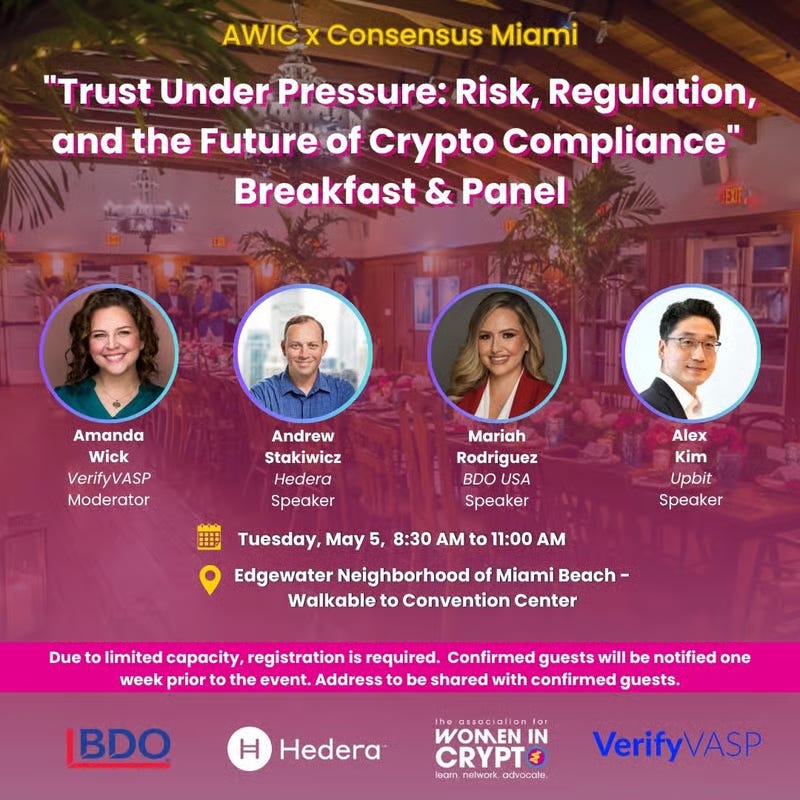
I am starting Monday morning at the AWIC breakfast panel, “Trust Under Pressure: Risk, Regulation, and the Future of Crypto Compliance,” hosted alongside Consensus with BDO, Hedera, and VerifyVASP. The panel focuses on Travel Rule implementation, counterparty risk assessment, and where public-private coordination on compliance is actually working versus where it is performative. That conversation is a direct complement to what I expect to come out of the Regulation and Policy Summit on the main floor - and probably a more honest version of it.
I will also be dialing into Wealth Management Day on the 6th - a closed-door forum for financial advisors and wealth managers covering fiduciary risk, regulation, and client-facing communication on digital assets. This is the conversation that maps most directly to where my readership sits, and I am particularly interested in how advisors are framing digital assets and tokenization for clients who are not yet in the room.
On the 7th, I will be at the AWIC Facilitated Networking Session, a structured event organized by the Association for Women in Cryptocurrency that brings together compliance, risk, policy, legal, and innovation professionals. As Founding Treasurer of the AWIC San Francisco Chapter, I am most looking forward to this conversation. The people in that room are doing some of the less visible but structurally important work in this space.
Beyond those anchors, I am paying attention to the conversations that do not happen on stage - the exchanges between asset managers who flew in from somewhere that is not New York, the founders building infrastructure the broader industry has not heard of yet, and the legal and compliance professionals quietly doing the hardest parts of this work.
That layer is where the most useful signal tends to live.
What Comes Next
I am planning to publish from the floor while I am in Miami, shorter dispatches as conversations happen, rather than waiting until I am back. The deeper follow-up reporting and analysis will come after, once there is time to assess what actually moved versus what was just well-packaged for a conference audience.
On the 13th, the AWIC San Francisco Chapter is hosting a panel directly relevant to everything Consensus is going to surface: San Francisco AWIC Panel: How Compliance, Risk and Regulation Are Shaping Digital Assets - and I am excited to be meeting with a few panelists while at Consensus, which I personally believe, means the conversation on the 13th will benefit from whatever comes out of Miami, feeding directly into it. If you are in San Francisco, register. If you are not, it is virtual and open to members and non-members.
If there is a specific regulatory question, infrastructure segment, or conversation thread from this week that you want me to dig into further, reply and let me know. I read everything.
The RWA Ledger exists because this space needs analysis rigorous enough for the people actually building and allocating in it. Consensus Miami is three days where a significant amount of that work becomes visible. I will be there.
About The RWA Ledger
The RWA Ledger is a research and media platform focused on tokenization and the evolution of financial infrastructure toward more verifiable, on-chain systems. Each piece analyzes how these systems intersect with real-world financial infrastructure -- including regulation, custody, risk, and operational constraints -- with a focus on what actually drives institutional adoption beyond the crypto-native environment.
The publication is written and edited by Marina Mendenhall-Valente, Founder and Principal of The RWA Ledger and Founding Treasurer of the AWIC San Francisco Chapter. Marina works at the intersection of digital asset strategy, institutional finance, and market development through The RWA Ledger and Tiburon Advisory Group.
All views expressed are my own.
Looking forward to the real time updates from Consensus. 👏🏻👏🏻