

At The RWA Ledger, we cover various aspects of tokenizing RWAs at the intersection of market structure and regulation, including, most importantly, considerations for founders, institutions, and regulators navigating this space. That includes updates coming out of Capitol Hill and the impacts those changes may have on existing operational assumptions for the people building and deploying in this space. The hearing on Wednesday, March 25th, produced several meaningful takeaways, including at least one that has gone largely unreported. We're calling it out here, alongside a clear-eyed read on what the session confirmed, what it left unresolved, and what it means for founders, institutions, and regulators working through tokenization strategies right now.
The hearing on Wednesday, March 25th, before the House Financial Services Committee, titled "Tokenization and the Future of Securities: Modernizing Our Capital Markets," made clear that while legislation around tokenized assets is still pending, there is bipartisan consensus that tokenized securities are inevitable. Rep. Andy Barr, R-Ky., put it plainly during the hearing: "No doubt tokenization of securities is coming. It's here, and our modernization of our securities regulation is required, both in terms of preserving that gold standard of investor protection, but also making sure that the United States is leading the way." Wednesday's session also arrived as the SEC prepares to roll out a potential innovation exemption for tokenized assets, with Chairman Paul Atkins confirming the exemption is currently awaiting clearance from the Office of Information and Regulatory Affairs and could be introduced within weeks.
The Market This Hearing Was Asked to Govern
Going into the hearing, the on-chain RWA market stood at $26.48 billion in distributed value, up 5.25% in the prior 30 days. That number alone, however, obscures something important: not all tokenized products are equal; just as not all entrants who aim to embrace tokenization will make it, they are as structurally different from one another as the firms embarking on offerings of tokenized assets themselves. Much of the nuance those products carry includes specific risk profiles and ownership structures we will get to shortly, but perhaps even more important is the role of distribution channels, partnerships, and integration with keystone players like Franklin Templeton, BlackRock, and other institutional firms that enable a landscape right for opportunity, even when the inevitable cycle turns.
Financial innovation has always carried with it a notorious reputation for spurring booms and busts; looking back at cycles like the Panic of 1873 (railroad speculation), the Great Depression (1929), the 1970s Stagflation (OPEC oil shock), and the Dot-com Bubble (2000–2002), each bust has consistently revealed the asymmetry in who bears the risk at the point of failure rather than at the point of design.
Railroad speculation in 1873 was built on genuine infrastructure with transformative potential; capital poured in, driven in large part by banker Jay Cooke whose firm financed the Northern Pacific Railway, and when the speculation collapsed, culminating in 89 of the country's 364 railroad companies going bankrupt, it triggered a cascade that reached even into Germany, where a parallel speculative bubble-burst became known as the Gründerkrach, or "Founders' Crash."
Fast forward 125 years, and The Dot-com era followed the same structural pattern, with its own version of what we are now watching resurface: IPO mania. Between 1995 and 2000, the Nasdaq index experienced a five-fold increase, peaking in March 2000 before plummeting nearly 77% by October 2002, as companies raised significant capital in public markets despite lacking viable business models, and when investment funds dried up, the reckoning was swift. Amazon, eBay, and Priceline survived; the majority did not.
Today, a similar dynamic is taking shape, call it “Valuation Mania.” This time, driven by AI and crypto, where companies like OpenAI are commanding $730 billion pre-money valuations in private markets ahead of anticipated public listings, and the IPO pipeline for AI infrastructure, fintech, and digital asset companies is among the largest in recent memory, per Barron's. The underlying technology, as in 1873 and 2000, is real; the trajectory is directionally correct; and the timing and valuation assumptions are, once again, the open question, with losses, if they come, most likely to concentrate farthest from the decision-making.
What made each crisis worse was not the innovation itself, but the absence of frameworks capable of distinguishing sustainable adoption from speculative overhang, and the regulatory gap that allowed both to be labeled the same thing.
Even though her sentiments generally fall at party line, and are often disparaging towards innovation, Ranking Member Maxine Waters' remarks carry weight. Referencing the 2008 financial crisis, she cautioned: "Leading up to the 2008 financial crisis, we were told that securitization and new financial technologies would make borrowing easier, spread risk, and lift everyone up. What they actually did was allow Wall Street to build a process that legitimized predatory loans, stripped wealth from middle-class homeowners, and created the conditions for the worst economic catastrophe since the Great Depression;" a parallel worth considering, and one that argues not against tokenization, but for getting the architecture right before the capital scales, which is precisely what the hearing, imperfectly and incompletely, began to do.
Not a Single Category - What the Market Actually Contains
The morning of the hearing, we published On the Ledger No. 001, Sandy Kaul’s institutional breakdown of RWA tokenization, "Revolution—Not Evolution" LinkedIn Newsletter. The specific article in reference is “Detangling Tokenization.” Her central argument is worth carrying directly into this analysis: what is being called tokenization today is not a single category; it is a set of structurally different models, synthetic exposure tokens, digitally native tokenized assets, and digital twin structures, each carrying distinct implications for ownership rights, settlement mechanics, and where the authoritative record of ownership actually resides. Those differences are often obscured at the point of evaluation and become highly visible at the point of failure, precisely the dynamic the historical parallels above describe.
Evaluated through Sandy's taxonomy lens, BlackRock's BUIDL fund, Franklin Templeton's BENJI token, JPMorgan's Kinexys platform, and Circle's on-chain products do not operate on the same model, and they do not carry the same risk profile. Some sit closer to synthetic structures where the token represents a claim on an intermediary; some are digitally native; and some, including the DTCC and NYSE approaches referenced directly by witnesses at the hearing, sit closer to the digital twin end, where the authoritative record remains in traditional financial infrastructure and the token functions as a reference layer above it. These are the products that were implicitly under discussion on Wednesday, and the distinctions between them are not peripheral to the regulatory conversation; they are the regulatory conversation.
Where Settlement Risk, Custody, and Investor Protection Actually Land
There is an understanding that theory is different from practice, and this holds true for settlement risk, custody obligations, and investor protections, which vary depending on the model in use. Current securities law was written without these structures in mind, and the consequences of that gap have already given us a glimpse of what can happen when regulatory frameworks are unprepared to meet the market where it’s at. Celsius Network had approximately 600,000 accounts in its Earn program when it collapsed in 2022. Users believed they held crypto assets; the bankruptcy court found they had transferred full title and ownership to Celsius under the Terms of Use, making them unsecured creditors with a $4.7 billion claim against an estate with a $1.3 billion hole in its balance sheet. The gap between what the on-chain presentation showed and what users actually owned became apparent only after withdrawals were frozen. That is the synthetic-structure failure mode in practice: indirect ownership through an intermediary, the absence of governance rights, and the discovery that settlement finality was assumed rather than guaranteed.
For synthetic structures more broadly, the specific risks include indirect ownership through an intermediary SPV, absence of governance rights, and the gap between apparent on-chain settlement finality and the actual off-chain settlement timeline of the underlying asset - a timing mismatch that introduces counterparty exposure that on-chain presentation does not eliminate. For digitally native structures, the constraints shift to permissioned environments, reduced composability, and integration complexity with existing custody and reporting systems. For digital twin structures, as we noted in our earlier piece on Atomic Settlement, Tokenized Securities, and the SEC, the underlying settlement architecture remains unchanged, meaning tokenization improves the interface without altering the architecture, and the legacy infrastructure constraints do not disappear because a token sits on top of them.
The question that runs underneath all of Wednesday's testimony is this: when regulators, legislators, and institutional operators talk about investor protection in the context of tokenized securities, which tokenization model are they describing? The answer shapes every downstream decision about settlement finality, custody standards, and what recourse actually exists if an underlying structure fails. The Senate Banking Committee markup targeted for late April, the SEC's March 18 approval of Nasdaq's tokenized securities pilot with first trades anticipated by end of Q3 2026, and the joint SEC-CFTC interpretive release published March 17 will all begin to put pressure on these questions — but none of it resolves the structural distinctions Sandy identifies or the legislative gaps the hearing put on the record.
The Constraints the CLARITY Act Won't Touch
The session assembled witnesses across the full institutional spectrum - SIFMA, the Blockchain Association, Nasdaq, DTCC, and Kimber Labs - and that composition alone was a signal: the architects of traditional market plumbing and the builders of new rails were sitting at the same table, making the case to the same committee at the same moment.
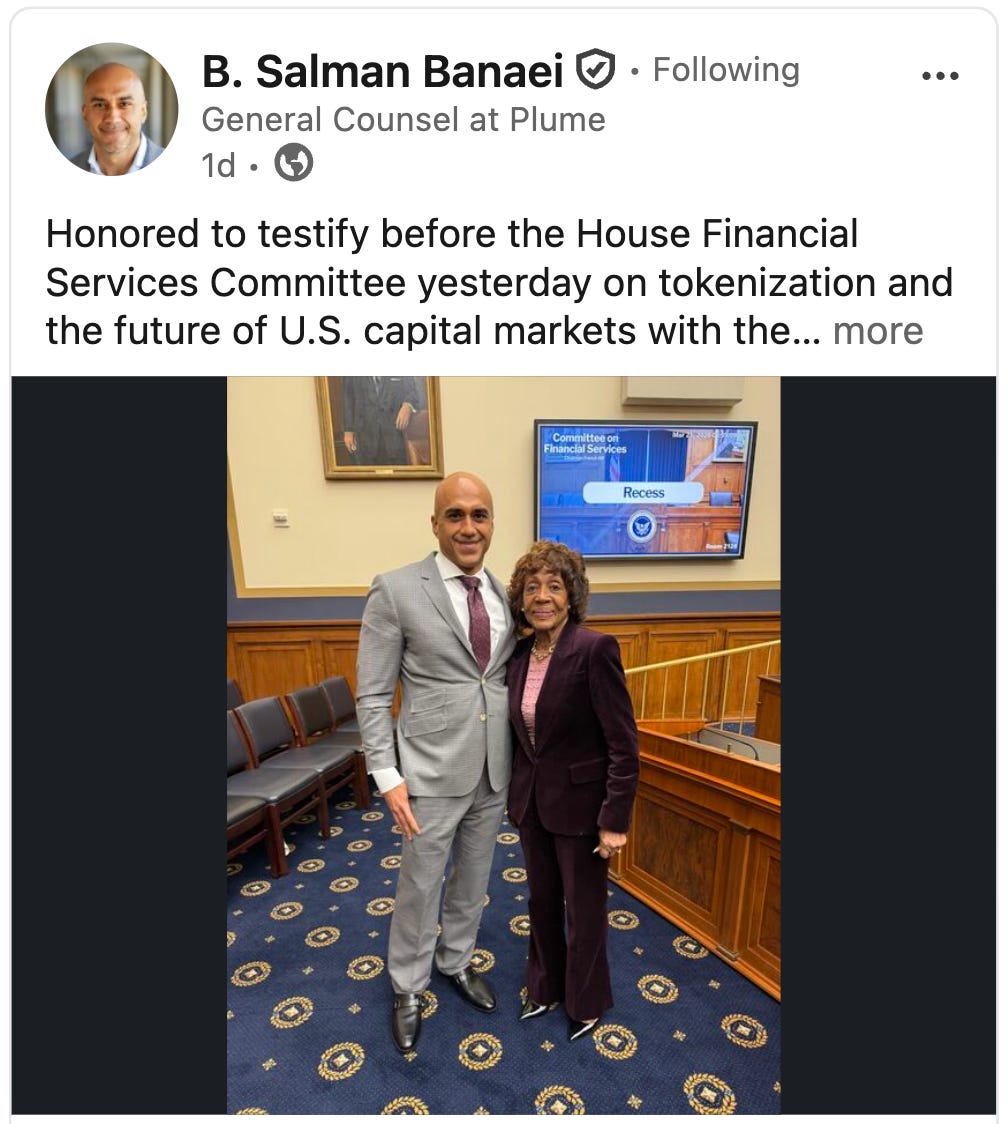
The most substantively important testimony came from Salman Banaei of Kimber Labs, and it surfaced a blocker that has received almost no public attention before or since. The stakes, in his own words, were direct: "The question before this Committee is whether American capital markets infrastructure and American regulatory frameworks will channel that demand or whether foreign competitors with different geopolitical objectives will capture it."
TEFRA Enters The Chat
The Tax Equity and Fiscal Responsibility Act of 1982 was written to prevent the issuance of bearer bonds, which were used to facilitate money laundering and tax evasion. Four decades later, it now inadvertently prohibits the issuance of tokenized bonds on any permissionless public blockchain where transfers occur between self-custodied wallets without involvement of a traditional book entry system. Peer-to-peer token transfers are functionally indistinguishable from bearer bonds under TEFRA's current language, and the penalties are consequential: denial of interest deductions, excise taxes at issuance, reclassification of capital gains as ordinary income, and denial of the portfolio interest exemption, exposing interest payments to 30% withholding regardless of the investor's residence.
The global bond market represents over $140 trillion in outstanding debt, per SIFMA's 2026 estimates (Banaei's testimony used the OECD figure of over $100 trillion, which covers a narrower dataset), and the US accounts for approximately $58.2 trillion of that. Singapore, the UK, and the EU are actively building frameworks to capture tokenized bond issuance. An unintended consequence of a 1982 tax statute is one structural reason the US is behind, and it requires separate legislative action from the CLARITY Act entirely. If you are building a tokenization strategy for fixed-income assets on permissionless public chains with self-custodied wallet transfers, have you stress-tested your architecture against TEFRA? The constraint exists now, and building around it requires knowing it exists.
TEFRA is the most underreported statutory barrier, but it sits within a broader stack of structural constraints that explain why the RWA market grows at a measured 5–6% monthly rather than the exponential trajectory some projections have assumed. These constraints fall across three layers, each requiring a different kind of response.
The first layer is statutory. Alongside TEFRA, stablecoin legislation remains in the implementation phase; tokenized securities need a cash leg for settlement, and without a regulated stablecoin or wholesale CBDC, on-chain settlement carries a structural gap regardless of what the CLARITY Act resolves. These gaps require Congressional action, and neither has yet surfaced in any active legislative vehicle beyond what Wednesday's session began to frame.
The second layer is structural market architecture. Basel capital surcharges apply a 1,250% risk weight to permissionless blockchain assets, rendering bank participation in public-chain tokenization commercially unviable without reform. Layered on top of that, liquidity fragmentation across chains creates 1–3% pricing gaps for identical assets and 2–5% friction when moving capital cross-chain, a constraint that compounds as products scale and secondary markets deepen.
The third layer is behavioral. The macroeconomic rate environment has blunted the on-chain value proposition; US money market funds returned 4.2–5.3% annually in 2023–2024 while base stablecoin lending rates clustered lower, narrowing the yield argument for on-chain deployment. More directly, 66% of institutional investors cite regulatory uncertainty as their primary concern when investing in digital assets, and 78% identify market structure specifically as the area most in need of clear regulatory guardrails, per a January 2026 EY-Parthenon and Coinbase survey of 351 institutions. The capital is present and growing — 73% of respondents plan to increase crypto allocations in 2026 — but the frameworks that would give that capital durable confidence are still being assembled.

Although the CLARITY Act, if enacted, could clarify jurisdictional issues, it does not resolve any of the other concerns mentioned above.
The Legislative Stack and the Clock
The CLARITY Act passed the House 294-134 in July 2025. The Senate Banking Committee markup is targeted for late April. Senator Bernie Moreno has set the outer limit plainly: if the bill does not reach the Senate floor by May, digital asset legislation may not advance again for years. The competitive pressure behind that deadline reflects several converging forces: a November 2026 midterm calendar that effectively closes the Senate floor to controversial legislation by August, competing priorities that CoinDesk has reported include the war in Iran and Trump's SAVE America Act demands, and the measurable cost of delay - $952 million in crypto ETP outflows attributed directly to CLARITY Act uncertainty, per CoinShares Head of Research James Butterfill.

The same week as Wednesday's hearing, Rajya Sabha Member of Parliament Raghav Chadha introduced a Private Member’s Bill, “The Asset Tokenisation (Regulation) Bill, 2026,” in the Upper House on Friday, aiming to establish a clear legal and regulatory framework for tokenised real-world assets in India. The last time a private member bill was enacted in India was 1970, but it signals policymaking intent in a jurisdiction that has historically exported digital asset activity offshore. Whether it advances or not, it adds to a growing list of jurisdictions, Singapore, the UK, and the EU among them, actively developing frameworks while US statutory clarity remains unresolved.
In parallel, the SEC and CFTC published a joint 68-page interpretive release on March 17th, formally entered into the Federal Register on March 23. The release established a five-category token taxonomy - digital commodities, digital collectibles, digital tools, stablecoins, and digital securities - and explicitly named 16 crypto assets as digital commodities not subject to securities law. The interpretation carries immediate persuasive authority but does not constitute formal rulemaking or carry the binding force of a statute. Both SEC Chairman Paul Atkins and CFTC Chairman Michael Selig have said publicly that only Congress can provide the statutory foundation, and that they stand ready to implement the CLARITY Act the moment it reaches the President's desk.
Two draft bills surfaced at Wednesday's session and have not yet been formally introduced. The Modernizing Markets Through Tokenization Act of 2026 would require a joint SEC-CFTC study on tokenized derivatives, compelling both agencies to address their jurisdictional standoff. The Capital Markets Technology Modernization Act codifies broker-dealers' right to use blockchain-based record-keeping under existing law. Both are early-stage measures, neither resolves TEFRA, Basel risk weights, or cross-chain liquidity fragmentation, and they are the beginning of an iterative legislative architecture rather than the end of one.
Mersinger's testimony made the case that the SEC already has the tools to support responsible progress through exemptive relief and iterative pathways, and should use them now rather than waiting for a complete statutory framework that may take years to produce. The SEC's March 18 approval of Nasdaq's tokenized securities pilot, with first trades anticipated by end of Q3 2026 pending DTC system readiness, is one indication that some institutions are already moving on that basis.
The Architecture of Survival
The hearing confirmed that tokenization is coming. It did not confirm that every firm currently building in this space will continue to do so as the infrastructure matures. That distinction is worth naming directly, because the historical pattern is consistent on this point: in every prior cycle, the survivors were not the fastest movers. They were the ones who understood which constraints were permanent, which were transitional, and which were political, and built their architecture accordingly.
What positioning actually looks like in this environment is more diagnostic than directional. It starts with knowing which tokenization model you are actually building on or allocating into, because the model determines the failure mode. A synthetic structure that looks liquid in normal markets may expose holders to redemption queues and off-chain settlement delays under stress; a digital twin structure that looks familiar to institutional infrastructure may be constrained by the same batch settlement cycles it was supposed to replace. Distribution matters here in a way that is often underestimated: the firms that built durable institutional channels before the cycle matured - the Franklin Templetons and BlackRocks that deployed early with model integrity and regulatory alignment - will define the benchmark against which later entrants are evaluated.
For founders, the distinction between runway and strategy has never been more consequential. Pets.com raised $82.5 million, ran a Super Bowl ad, and was out of business within nine months. Chewy launched seven years later with a fraction of that capital and sold to PetSmart for $3.35 billion. The runway did not determine the outcome; the architecture did. A firm with eighteen months of runway and a model built on TEFRA-constrained fixed-income tokenization on a permissionless chain has a different problem than one with six months of runway and institutional-grade synthetic exposure with established distribution.
For institutions, the equivalent question is whether the internal review process matches the pace at which counterparties are positioning. The SEC approved Nasdaq's tokenized securities pilot on March 18. NYSE has partnered with Securitize. These are not experiments; they are competitive positioning by the infrastructure layer itself. The firms still running internal feasibility studies are doing so against a market that has already made several decisions about which models and distribution architectures will carry institutional volume.
What Has Actually Changed
The dominant operating assumption before Wednesday was that regulatory clarity unlocks adoption. The hearing put a more accurate framing on the record: regulatory clarity is necessary, but so is tax law modernization on TEFRA, Basel reform on permissionless chains, stablecoin settlement infrastructure, and cross-chain liquidity solutions. None of those gets resolved by a single piece of legislation. The teams calibrating their timelines for CLARITY Act passage should ask which of their constraints the bill actually affects.
What the hearing produced is a formal acknowledgment that the current framework is broken for this market. Chairman French Hill described tokenization as a structural transformation in how securities are issued, traded, and recorded - the first time a committee chair has placed that characterization on the record. The question of whether Washington will engage seriously with this has been answered. The questions of which chain, which settlement mechanism, which regulatory pathway, and which legal structure remain open.
The Questions That Remain
What follows is not a summary. It is a set of questions that the hearing raised without resolving, directed at people for whom the answers are not academic.
For founders and builders: the wait-for-clarity strategy now has a hard deadline attached. Have you audited your architecture against TEFRA, Basel risk weights, and stablecoin settlement assumptions? Resolving TEFRA requires separate Congressional action from the CLARITY Act; it will not be addressed even in the most optimistic legislative scenario. Building around it now is a strategic choice, not a future consideration.
For institutions: the model-level distinctions from Sandy’s taxonomy are a more useful due diligence lens than headline market size. Which model underlies what you are evaluating, and are the ownership rights, settlement finality, and counterparty exposure compatible with your operating framework? The IMF’s warning about composability risk in synthetic structures is not a reason to avoid the market; it is a reason to know exactly which part of it you are in. Are your internal systems capable of executing settlement, compliance, and custody obligations in real time if settlement expectations compress — a dynamic we examined in Atomic Settlement, Tokenized Securities, and the SEC?
For regulators: the iterative pathway is where meaningful near-term progress is most likely, and the joint SEC-CFTC taxonomy release provides both agencies with a foundation to move forward. On TEFRA, the pathway is Congressional - neither agency can address it through guidance or exemptive action alone. The last time a financial innovation cycle outpaced its regulatory framework, the cost was borne by the people furthest from decision-making. That outcome is not inevitable this time; it is a design choice.
For advisors and wealth managers: if a client asks what they own in a tokenized product, the answer depends entirely on which model underlies it. The gaps between on-chain representation and off-chain legal reality are harder to explain than anything traditional wealth management has previously required. In every prior cycle, it was the intermediaries closest to clients who bore the reputational cost of that gap first. The question is whether this time it gets named before it gets discovered.
Less than 0.1% of the world’s assets are currently tokenized. The last time we were told a new financial technology would spread risk more efficiently and democratize access to capital, it did - just not in the direction anyone intended. That does not make tokenization the same story. It makes the architecture of how it gets built the most consequential variable in whether it ends differently.
The RWA Ledger covers tokenization and the evolution of financial infrastructure toward more verifiable, on-chain systems. This briefing reflects analysis based on publicly available hearing materials, testimony, and market data as of March 28, 2026.